Sunday, July 21, 2024

Email to Wes

Corey spent a good chunk of time today looking at some videos from a guy named Mike that Wesley shared with him last week, so that he could help him with the discussion. Corey sent him 4 emails:

“How Joseph Smith Tried to Write Himself Into the Bible” first 4:22 minutes

“How Joseph Smith Tried to Write Himself Into the Bible”

·         “You will not believe what Joseph Smith added to the Bible, I mean literally added to the Bible a lot of stuff……There is a reason the LDS Church, the Mormon Church never talks about this book because it has very revealing issues in it”.

He’s implying that the church is somehow embarrassed of the JST? I’m a lifelong member and I’ve never got that vibe – this is a new accusation to me.

“One reason, therefore, that the LDS Church did not print the entire JST is that the Church did not possess the JST manuscript. The RLDS Church (now known as the Community of Christ), which first published the JST in 1867, owned the JST manuscripts and the copy­right. When the LDS edition was being prepared for publication in the 1970s, we sought for and received permission from the RLDS Church to use portions of the JST in our scriptures. Though RLDS and LDS relations had been improving, there was concern that had we asked for permission to use all of the JST changes, we may not have gotten any of them. We are fortunate and blessed to have that portion of the JST we do have.”

https://rsc.byu.edu/vol-5-no-2-2004/precious-truths-restored-joseph-smith-translation-changes-not-included-our-bible

·         There are references to Joseph Smith in the Bible that are not part of the JST.

o   Isaiah 29:11 – Talks about the experience of Charles Anthon

·         “Religious Pornography” - to religious pornography. Something that is sacred and meant for personal reflection and commitment and throws it before the masses in a selective, salacious, and superficial way.

·         If you’re a Mormon, I care about you. I really care about you. I’m not bashing you. I’m not hating on you.

Dr. Hugh Nibley wrote a paper called “How to Write an Anti-Mormon Book”
https://archive.interpreterfoundation.org/nibley/pdf/How-to-Write-an-Anti-Mormon-Book-B.pdf

"Protest your love for the Mormon people. Show your tolerant and humane attitude by allowoing the Mormons a few human failings -- that will make your story more plausible and for that reason more damning."

·         If Joseph Smith is really a prophet, I want to submit my life to what he says. If not, then I want to rescue you from what he says.


·         Latter-day Saints have been taught that the Bible has been … radically changed over the years. I don’t know that we’ve said it was “radically changed” only that some plain and precious truths have been lost. We really don’t want to be bashing the Bible but it is not inerrant (meaning free from error). I believe it is remarkably consistent and reliable, but there are over 450 English versions since Tyndale’s 1526 version. (https://www.patheos.com/answers/how-many-versions-of-the-bible). Nobody is suggesting the Bible is not the word of God – but it has passed through many, many hands over the centuries and it is provable that some things have been modified.


·         Yes, there have been some changes in the Book of Mormon over the years – mostly to make it read more in line with modern-day speaking. In it’s more original form, the Book of Mormon is truer to (for example) Hebrew grammar and even older English. The original Book of Mormon didn’t have any punctuation. Grammar and spelling were fixed, and some changes in printing were made to make it more in line with the original manuscript.
https://www.fairlatterdaysaints.org/answers/Book_of_Mormon/Textual_changes/Why_were_these_changes_made#:~:text=23%2D26).-,There%20are%20over%20100%2C000%20insignificant%20changes%20that%20have%20been%20made,is%20well%20over%20100%2C000%20changes.


·         “If you get ahold of an old Book of Mormon compared to a new one you’ll see that the racism that is in there has been systematically pushed aside and altered so that it wouldn’t be perceived that way”. I’m unfamiliar with this one. This is a great line because he’s able to off-hand claim the Book of Mormon for being racist while it's clear that is not his main point. The implication is that the church has modified stuff to cover up their evil/racist origins. I’m assuming he’s talking about a verse like 2 Nephi 5:20-25 which is about as rough as it gets (lots of context needed). I’m not sure what denomination of Christianity Mikie Winger belongs to, but a lot of our critics come from the Southern Baptists, who split from the church in 1845 in support over slavery – which has always struck me as ironic.

We don’t have almost anything of the Original Manuscript (what was originally translated by Joseph Smith) but we do have copies of the Printers manuscript online here. Some errors were introduced with the Printers Manuscript. I don’t see any changes beyond punctuation, spelling fixes – certainly nothing that would change it’s meaning.

https://www.josephsmithpapers.org/paper-summary/printers-manuscript-of-the-book-of-mormon-circa-august-1829-circa-january-1830/61

Printers Manuscript:

wherefore the word of the Lord was fulfiled which he spake unto me saying that in as much as they will not hearken unto thy words they shall be cut off from the presance of the Lord & behold they were cut off from his presance & he had caused the cursing to come upon <them> yea even a sore curseing because of their iniquity for behold they had heardened their hearts against him that they had become like unto a flint wherefore as they were white & exceding fair & delightsome that they might not be enticeing unto my People therefore the Lord God did cause a skin of blackness to come upon them [p. 57] & thus saith the Lord God I will cause that they shall be loathsome unto thy People save they shall repent of their iniquities & cursed shall be the seed of him that mixeth with their seed for they shall be cursed even with the same cursing & the Lord spake it & it was done & because of their cursing which was upon them they did become an idle People full of mischief & subtelty & did seek in the wilderness for beasts of pray & the Lord God said unto me they shall be a scorge unto thy seed to stir them up in rememberance of me & in as much as they will not remember me & hearken unto my words they shall scorge them even unto destruction

Current-day version:

20 Wherefore, the word of the Lord was fulfilled which he spake unto me, saying that: Inasmuch as they will not hearken unto thy words they shall be cut off from the presence of the Lord. And behold, they were cut off from his presence.

21 And he had caused the cursing to come upon them, yea, even a sore cursing, because of their iniquity. For behold, they had hardened their hearts against him, that they had become like unto a flint; wherefore, as they were white, and exceedingly fair and delightsome, that they might not be enticing unto my people the Lord God did cause a skin of blackness to come upon them.

22 And thus saith the Lord God: I will cause that they shall be loathsome unto thy people, save they shall repent of their iniquities.

23 And cursed shall be the seed of him that mixeth with their seed; for they shall be cursed even with the same cursing. And the Lord spake it, and it was done.

24 And because of their cursing which was upon them they did become an idle people, full of mischief and subtlety, and did seek in the wilderness for beasts of prey.

25 And the Lord God said unto me: They shall be a scourge unto thy seed, to stir them up in remembrance of me; and inasmuch as they will not remember me, and hearken unto my words, they shall scourge them even unto destruction.

“How Joseph Smith Tried to Write Himself Into the Bible” 4:22 - 8:30

“How Joseph Smith Tried to Write Himself Into the Bible”

·         “You will not believe what Joseph Smith added to the Bible, I mean literally added to the Bible a lot of stuff……There is a reason the LDS Church, the Mormon Church never talks about this book because it has very revealing issues in it”.

He’s implying that the church is somehow embarrassed of the JST? I’m a lifelong member and I’ve never got that vibe – this is a new accusation to me.

“One reason, therefore, that the LDS Church did not print the entire JST is that the Church did not possess the JST manuscript. The RLDS Church (now known as the Community of Christ), which first published the JST in 1867, owned the JST manuscripts and the copy­right. When the LDS edition was being prepared for publication in the 1970s, we sought for and received permission from the RLDS Church to use portions of the JST in our scriptures. Though RLDS and LDS relations had been improving, there was concern that had we asked for permission to use all of the JST changes, we may not have gotten any of them. We are fortunate and blessed to have that portion of the JST we do have.”

https://rsc.byu.edu/vol-5-no-2-2004/precious-truths-restored-joseph-smith-translation-changes-not-included-our-bible

·         There are references to Joseph Smith in the Bible that are not part of the JST.

o   Isaiah 29:11 – Talks about the experience of Charles Anthon


·         “Religious Pornography” - to religious pornography. Something that is sacred and meant for personal reflection and commitment and throws it before the masses in a selective, salacious, and superficial way.


·         If you’re a Mormon, I care about you. I really care about you. I’m not bashing you. I’m not hating on you.

Dr. Hugh Nibley wrote a paper called “How to Write an Anti-Mormon Book”
https://archive.interpreterfoundation.org/nibley/pdf/How-to-Write-an-Anti-Mormon-Book-B.pdf

"Protest your love for the Mormon people. Show your tolerant and humane attitude by allowoing the Mormons a few human failings -- that will make your story more plausible and for that reason more damning."


·         If Joseph Smith is really a prophet, I want to submit my life to what he says. If not, then I want to rescue you from what he says.


·         Latter-day Saints have been taught that the Bible has been … radically changed over the years. I don’t know that we’ve said it was “radically changed” only that some plain and precious truths have been lost. We really don’t want to be bashing the Bible but it is not inerrant (meaning free from error). I believe it is remarkably consistent and reliable, but there are over 450 English versions since Tyndale’s 1526 version. (https://www.patheos.com/answers/how-many-versions-of-the-bible). Nobody is suggesting the Bible is not the word of God – but it has passed through many, many hands over the centuries and it is provable that some things have been modified.


·         Yes, there have been some changes in the Book of Mormon over the years – mostly to make it read more in line with modern-day speaking. In it’s more original form, the Book of Mormon is truer to (for example) Hebrew grammar and even older English. The original Book of Mormon didn’t have any punctuation. Grammar and spelling were fixed, and some changes in printing were made to make it more in line with the original manuscript.
https://www.fairlatterdaysaints.org/answers/Book_of_Mormon/Textual_changes/Why_were_these_changes_made#:~:text=23%2D26).-,There%20are%20over%20100%2C000%20insignificant%20changes%20that%20have%20been%20made,is%20well%20over%20100%2C000%20changes.


·         “If you get ahold of an old Book of Mormon compared to a new one you’ll see that the racism that is in there has been systematically pushed aside and altered so that it wouldn’t be perceived that way”. I’m unfamiliar with this one. This is a great line because he’s able to off-hand claim the Book of Mormon for being racist while its clear that is not his main point. The implication is that the church has modified stuff to cover up their evil/racist origins. I’m assuming he’s talking about a verse like 2 Nephi 5:20-25 which is about as rough as it gets (lots of context needed). I’m not sure what denomination of Christianity Mikie Winger belongs to, but a lot of our critics come from the Southern Baptists, who split from the church in 1845 in support over slavery – which has always struck me as ironic.

We don’t have almost anything of the Original Manuscript (what was originally translated by Joseph Smith) but we do have copies of the Printers manuscript online here. I don’t see any changes beyond punctuation, spelling fixes – certainly nothing that would change it’s meaning.

https://www.josephsmithpapers.org/paper-summary/printers-manuscript-of-the-book-of-mormon-circa-august-1829-circa-january-1830/61

Printers Manuscript:

wherefore the word of the Lord was fulfiled which he spake unto me saying that in as much as they will not hearken unto thy words they shall be cut off from the presance of the Lord & behold they were cut off from his presance & he had caused the cursing to come upon <them> yea even a sore curseing because of their iniquity for behold they had heardened their hearts against him that they had become like unto a flint wherefore as they were white & exceding fair & delightsome that they might not be enticeing unto my People therefore the Lord God did cause a skin of blackness to come upon them [p. 57] & thus saith the Lord God I will cause that they shall be loathsome unto thy People save they shall repent of their iniquities & cursed shall be the seed of him that mixeth with their seed for they shall be cursed even with the same cursing & the Lord spake it & it was done & because of their cursing which was upon them they did become an idle People full of mischief & subtelty & did seek in the wilderness for beasts of pray & the Lord God said unto me they shall be a scorge unto thy seed to stir them up in rememberance of me & in as much as they will not remember me & hearken unto my words they shall scorge them even unto destruction

Current-day version:

20 Wherefore, the word of the Lord was fulfilled which he spake unto me, saying that: Inasmuch as they will not hearken unto thy words they shall be cut off from the presence of the Lord. And behold, they were cut off from his presence.

21 And he had caused the cursing to come upon them, yea, even a sore cursing, because of their iniquity. For behold, they had hardened their hearts against him, that they had become like unto a flint; wherefore, as they were white, and exceedingly fair and delightsome, that they might not be enticing unto my people the Lord God did cause a skin of blackness to come upon them.

22 And thus saith the Lord God: I will cause that they shall be loathsome unto thy people, save they shall repent of their iniquities.

23 And cursed shall be the seed of him that mixeth with their seed; for they shall be cursed even with the same cursing. And the Lord spake it, and it was done.

24 And because of their cursing which was upon them they did become an idle people, full of mischief and subtlety, and did seek in the wilderness for beasts of prey.

25 And the Lord God said unto me: They shall be a scourge unto thy seed, to stir them up in remembrance of me; and inasmuch as they will not remember me, and hearken unto my words, they shall scourge them even unto destruction.

·         “and new passages that clarify and enhance the message of the Bible” – yeah, that’s true and I appreciate why that freaks out some traditional Christians.


·         1 Nephi 13:28 – “Wherefore, thou seest that after the book hath gone forth through the hands of the great and abominable church, that there are many plain and precious things taken away from the book, which is the book of the Lamb of God.” Yup, that is our belief.


·         “Now the thing is if you read the Book of Mormon you don’t really learn a lot about Mormon teaching or theology because there’s not a whole lot of theology in it. There’s little things like what we have on the screen here and I’ll read to you in a second, but the real Mormon theology is found in like the Doctrine and Covenants, the Pearl of Great Price, the Book of Abraham then there’s some real changes in theology. The Book of Mormon is more just a long story that was meant to explain Native Americans and their sort of experiences with God since they were more recently discovered on the scene of Western culture. And he thought he could explain that and that was one of the things that drew people to Mormonism” – I’m sort of losing interest. He seems to claim that 1) he understands Mormon theology 2) the Book of Mormon doesn’t contain Mormon theology. I’m beginning to suspect he’s never read the Book of Mormon. Hearing him say that was a laugh-out-lout moment for me. Clearly he’s never read the book.


·         “Now there can be no argument here, a Mormon would agree with me this is their interpretation not just mine. The “great and abominable church” that’s the first century church and those shortly after the death and resurrection of Jesus Christ.” Uh, actually I disagree. I assume the first 100 years they were able to keep much of it together, but by the time you get to 325 AD (Nicene creed) you’re over 300 years and there is a big debate about the nature of God. So yeah, I’m sure there were some things lost that first 100 years, but that is super early in Christianity, and we’re big fans of the earlier period. I guess my objection is implying that we believe the very early church was “great and abominable” – we don’t believe that. But if he’s Protestant, he likely agrees with what Protestants have said about the Catholic Church. For example, One of Martin Luther’s main objection is that the Catholic Church had this practice of selling indulgences. You could give money to pay for your sins, and even the sins of loved ones who had died. Martin Luther accused Johann Tetzel, the Pope’s seller of indulgences as saying “"As soon as the coin in the coffer rings, the soul from purgatory springs." So we give the very early church a lot of grace but worry about the many, many, many years that followed – including the things that caused the Protestants to protest and break away. I listened to this podcast of a historian who was excommunicated from the church for her feminist writings (https://www.youtube.com/watch?v=quyv7ArmWqM). She went on a long spiritual journey outside of the church and studied very early Christianity for 30 years. She recognized the same theology and was ultimately rebaptized. I’m not recommending the video – it’s quite a tangent, but I wanted to give the source for the claim that some people recognize that our church is more consistent with the Christianity of the first century.


·         “Joseph Smith said all denominations where abominations, he thought everyone…the Mormon Church didn’t originally want to be called Christian because they were anti-Christian” Yikes! The original name of the church (from 1829-1834) was The Church of Christ. He’s referring to the first vision where he was told that “their creeds were an abomination”. The word abomination is super strong – that was leveled at the creeds. Yeah, he still had other criticism of the church, but the reason he was forbidden to join any of them likely had more to do with his unique role as the founder of the church so it wouldn’t look like the church was a break-off from another religion.

18 My object in going to inquire of the Lord was to know which of all the sects was right, that I might know which to join. No sooner, therefore, did I get possession of myself, so as to be able to speak, than I asked the Personages who stood above me in the light, which of all the sects was right (for at this time it had never entered into my heart that all were wrong)—and which I should join.

19 I was answered that I must join none of them, for they were all wrong; and the Personage who addressed me said that all their creeds were an abomination in his sight; that those professors were all corrupt; that: “they draw near to me with their lips, but their hearts are far from me, they teach for doctrines the commandments of men, having a form of godliness, but they deny the power thereof.”

20 He again forbade me to join with any of them; and many other things did he say unto me, which I cannot write at this time.

·         “Nowadays it has changed. ‘New Mormonism is totally different form Old Mormonism’” It’s more PC (politically correct” nowadays)”. That’s weird because in 1832 Joseph Smith gave us Doctrine and Covenants 76 which begins by proclaiming that Christ is the only Savior of mankind and the only source of salvation for men and women.


Below is an article showing that many people struggled to accept Doctrine and Covenants 76 which went against their tradition of a hardline doctrine of heaven for the select few or eternal damnation in hell for everyone else. People were mad that God wasn’t going send everlasting punishment to the wicked – it almost implied a universal salvation of sorts.

https://rsc.byu.edu/doctrine-covenants-revelations-context/universalism-revelations-joseph-smith

When God revealed to Joseph Smith and Sidney Rigdon that there was a place prepared for all, according to the light they had received and their rejection of evil and practice of good, it was a great trial to many, and some apostatized because God was not going to send to everlasting punishment heathens and infants, but had a place of salvation, in due time, for all, and would bless the honest and virtuous and truthful, whether they ever belonged to any church or not. It was a new doctrine to this generation, and many stumbled at it.[2]


My point is that the characterization of the early church that we said everyone else was going to hell, that they are all wrong or an abomination is false. Yes, we think certain things like ordinances are essential, which is why we freely offer them to anyone we can get a name and a birthdate for in the temple. And then we do the ordinances individually with a lot of care. You could argue we’re the most accepting of other Christians and our doctrine from the beginning has been that way.


He's claiming that were more PC (politically correct) lately by only now accepting other Christians – and he does this in a video literally attempting to prove our religion false. He now concedes we consider him a Christian, but most likely will not agree to consider Latte-day Saints as also being Christian.

“How Joseph Smith Tried to Write Himself Into the Bible” 8:22 to 33:36

Oops, on that last e-mail I accidentally copied everything from the first 4:22 minutes as well. Below are my thoughts up until minute 33:36. I'm a little bored now with the topic, but happy to do more if you think it's helpful.

·         By writing 1 Nephi 13 Joseph Smith “is setting us up so that later he can add stuff. He can bring new things because he goes and writes a book”. He’s implying that this was all part of Joseph’s plan and then uses Moses 1:42 as another example of Joseph setting us up by saying “men shall esteem my words as naught and take many of them from the book which though shalt write, I will raise up another like unto thee” – so Joseph Smith is setting himself up as the person who will restore what was lost. Mike wants us to remember Genesis in particular. So does that mean that Joseph’s primary reason to give us to the book of Moses is to insert himself in history as a future prophet? There is a lot of other info given in the book of Moses. From the beginning of the video I thought he was going to talk about the new content, but maybe he’s only going to focus on Joseph “inserting” info to build up himself? Mike Winger takes exception about Joseph comparing himself to Moses like Jesus does.


·         He says you can lookup the official Joseph Smith Translation on the lds.org website – that seems to contract what is implied in his first point – that the church is embarrassed about it?


·         He says Joseph Smith inserting himself into the Bible is damnable. Calls the Church of Jesus Christ of Latter-day Saints a “twisted religion” and he wants to get us out of it, and our family and friends that Joseph started for his own sake. What exactly did Joseph get out of it anyway? Wasn’t he murdered and persecuted most of his life?


·         John 1:1 – we already talked about this some in the other stuff I sent to you. I think he’s pointing out that the King James Version is a more direct/literal translation from the Greek. He quotes the ESV (English Standard Version) which relies on the original Greek. He’s probably right on that. He says there are 17 words in the original, but like 35 in the JST – so he’s upset it got a lot longer. He says “this is damn you straight to hell theology” – I wish he’d elaborate on why this would damn someone to hell. Is he talking about Joseph Smith for making the change or does it apply to those of us who believe it? He says it takes the identify of who Jesus is, ripped it out, and replaced it with nonsense. I’m not following why its nonsense. He says Joseph’s teachings simply don’t exist in the Bible so he had to change the Bible. What about baptism for the dead? What about the martyrdom of Stephen who say Christ standing on the right-hand of God? What about Jeremiah 1:5 about a pre-mortal life (my Christian friend Brian and Father David don’t believe in a pre-mortal life). There are plenty of places in the Bible that fit with the doctrine Joseph revealed. Lattery-day saints believe that Isaiah 29:11 is referring to the Joseph Smith story of the Book of Mormon, even without the differences in the Book of Mormon when quoting it – but in the original KJV.


·         1 Corinthians 15:40 – It sounds like this video is one your friend really paid attention to because it has the John 1:1 concern, but also the concern about the addition of the Telestial Kingdom. I think Mike Winger should acknowledge that in the same chapter, just a few verses beforehand, Paul is saying in verse 29 “Else what shall they do which are baptized for the dead, if the dead rise not at all? why are they then baptized for the dead?”. Moments ago he was saying that Joseph Smith had to change the Bible to fit with his damnable theology and that nothing in the Bible supported his teachings. But then when talking about 1 Corinthians 15 ignores one of the most common evidences that Joseph’s Smith’s teachers were Biblical. Who else teaches or practices baptism for the dead? Nobody does today except the Latter-day Saints. So Paul is teaching that there are bodies that are celestial and terrestrial and Mike says he knows what those are – I’m curious if he thinks Terrestial people are the ones that go to hell? He is upset there is a third category (Telestial) but I’m curious what he thinks about the Terrestial.


·         In 1 Corinthians 15:40-41 Mike reads from his Bible version that says there are heavenly (Celestial) bodies and earthly (Terrestial) so it’s comparing two. But then it says “there is one glory of the sun, and another of the omon, and another glory of the stars” – so the talk about bodies compares 2 and the talk about light compares 3. That seems weird. If the original was meant to only compare 2 (heavenly/earthly or celestial/terrestrial) why would Paul then make a comparison with three levels of glory/light. Makes me think something like Telestial might have been missing. After talking about the three degrees with light (sun, moon, stars) Mike’s own version says “so it is with the resurrection of the dead”.  He also seems to suggest its not talking about resurrected bodies – even though that is what it says in verse 42.


·         “Mormons generally speaking are taught that the Bible has been radically adjusted and changed over the years. It’s like the telephone game.” That’s not true, we don’t teach that. We believe the Bible to be the word of God. He quoted an Article of Faith saying we believe in the Bible. What evidence does he have that it has been radically changed? I feel like that is a lie.


·         He then shows a video by Kevin L Barney, and LDS apologist talking about 1 Corinthians 15:40 (https://www.fairlatterdaysaints.org/testimonies/scholars/kevin-l-barney). That’s interesting that they watching FAIR/apologetic conferences. The Kevin Barney guy says Joseph “harmonized the text of 1 Corinthains 15:40” to match with D&C 76 – which makes sense. He uses the word “neologism” which is defined as “a newly coined word or expression.” He thinks that is a funny admission that Joseph Smith just “made up” a new word. He refers to this as “scholarly blinders” by using a fancy way to admit Joseph made up a new word. He seems pretty excited about that. It’s true that Joseph made changes to the Bible to harmonize it with the other revelations. It is certainly possible that the first version of 1 Corinthians 15:40 had a third degree of glory, but probably the earliest versions we have access to do not. So either he restored an original version we can’t prove or he added words to harmonize it with D&C 76 – neither of which bother me if he was a true prophet. I don’t think you can use this as evidence he was a false prophet.


·         Mike says soon he’ll show us about a passage where “he added a whole passage to the Bible to say it was prophesy of himself. This is so caught red-handed right, so caught red-handed. False prophet. Hands down, no question about it” Looking forward to it.


·         Hebrews 7:3 – he seems not to know how to pronounce the word Melchizedek. He says our version of Melchizedek is different than in “Christianity”.  We also think of him as a type of Christ – meaning king-priest who literally ruled is Kingdom under his father…a prince of peace. I’m not sure he understands Hebrews 7:3. The KJV makes it sound like Melchizedek was “Without father, without mother, without descent, having neither beginning of days, nor end of life; but made like unto the Son of God; abideth a priest continually.” I guess Mike does believe that? I think Melchizedek did have a father and mother, but like Abraham was not ordained to the Priesthood because of lineage. His version makes it sound like Melchizedek had no father and son but resembles the Son of God. In the JST it says “and all those” to include more than just Melchizedek. I guess Mike is OK if Melchizedek is made like unto God, but it’s not OK for anyone else? So is that why the addition is problematic?


·         Mike says “anyone who makes their own translation to support their own sect is incredibly suspicious”. FYI, Mike quotes the ESV Bible version published in 2001 (according to Wikipedia) and "created by a team of more than 100 leading evangelical scholars and pastors."


·         “All those who receive this priesthood can become like the Son of God” – then the goes on about how Mormons think we can become like God which evangelicals don’t like. Psalm 82:6 says: “I have said, Ye are gods; and all of you are children of the most High.” Jesus quotes that passage in John 10:


33 The Jews answered him, saying, For a good work we stone thee not; but for blasphemy; and because that thou, being a man, makest thyself God.

34 Jesus answered them, Is it not written in your law, I said, Ye are gods?


The Jews in Jesus’ time were offended that he said he was God. Today’s mainstream Christians are offended that we believe that we can become like our Heavenly Father.

The Eastern Orthodox church has a belief they call Theosis – which is similar to what Latter-day saints call Exaltation. So, it’s not just us.

Theosis (Ancient Greek: θέωσις), or deification (deification may also refer to apotheosis, lit. "making divine"), is a transformative process whose aim is likeness to or union with God, as taught by the Eastern Catholic Churches and the Eastern Orthodox Church; the same concept is also found in the Latin Church of the Catholic Church, where it is termed "divinization". As a process of transformation, theosis is brought about by the effects of catharsis (purification of mind and body) and theoria ('illumination' with the 'vision' of God). According to Eastern Christian teachings, theosis is very much the purpose of human life. It is considered achievable only through synergy (or cooperation) of human activity and God's uncreated energies (or operations)


·         He says there is no version of the original Bible that compares with Joseph Smith’s translation – we don’t have the original, original version of the Bible. I hope that he doesn’t think that.


·         Genesis 50 in any other Bible ends with vs 26. He’s taking issue with 12 new verses that Joseph Smith adds (Book of Moses). He claims that Joseph Smith was trying to prove that there were prophecies about him in the Old Testament. I’ve never heard that before. Mik makes it sound like all these people are asking for Joseph to prove that he’s mentioned in the Old Testament and then he whips out the Book of Moses to prove it. I’ve never actually heard of people accusing him of not being a true prophet because he’s not mentioned in the Bible. I’d like to hear some of those accusations. Who is asking? He doesn’t understand the stick of Joseph/Ephraim. He actually gets a major doctrine wrong. He confuses things by making it sound like the “fruit” is the writings, but it is the “fruit of they loins” which shall write, and he says the fruit that comes from Joseph (of Egypt) was really meant to be the writings of Joseph Smith. He says “the fruit of the loins of who, Joseph, whose fruit is that going to be? Joseph Smith”. So he gets this all wrong. We claim the Book of Mormon is written by descendants of Joseph of Egypt, not Joseph Smith. He’s confused on what we believe and what the passage means. That’s a pretty bad misinterpretation and not one you get from the reading. He also says Joseph claims to have Jewish ancestry – I’ve never head that before. We think of the Jews as generally NOT of the lost 10 tribes of Israel, but we do believe Joseph (and others) are of the house of Israel. Jews trace their ancestry to tribes that inhabited the Kingdom of Judah, including Judah, Benjamin and partially Levi. It’s not clear he has a good understanding of the tribes of Israel. He really needs to mention Lehi, Nephi and characters in the Book of Mormon to correctly explain LDS theology on this point.


·         “Remember they’re called Latter-day Saints because they think in the Last Days was the time when Joseph Smith showed up”. I don’t know what to do with just thought it was odd. Are we the only ones who think that Christ is soon to come? That were in the last days before Christ comes?


·         He has this sort of snarky laugh when he says (first reading) “and they that seek to destroy him shall be confounded. Actually, people/a mob killed him and they weren’t confounded. That’s the actual history of it”. Is he suggesting that Joseph Smith said he would live forever? I interpreted those that “seek to destroy him” as similar to what Mike is doing. I gotta admit I felt a little offended at his flippant comment about the murder of Joseph. Was he glad that he was shot?


·         So there was this big tease at the beginning of the video that we wouldn’t believe what Joseph Smith added to the Bible, but his main thing was that he added himself into it and things that matched with other Latter-day Saint doctrine. Nothing about Moses 1:39 or any of the other powerful insights from the JST. Here is an article entitled “Major Doctrinal Contributions of the JST”  https://rsc.byu.edu/joseph-smith-translation/major-doctrinal-contributions-jst . I feel like anti-Mormons know weird stuff. They skirt on the edges but they never really get much understanding because they avoid the content of the scriptures Joseph brought forth. Maybe they don’t want to get tainted?


·         “Mormons have been brought up to believe the Bible has been utterly corrupted over time” – that isn’t what we believe. It does appear that Mike is utterly corrupting what it is that we believe as Latter-day Saints. We’re not trying to attack the Bible.


·         1948 the oldest book of Genesis in Hebrew was discovered. He’s talking about the Dead Sea Scrolls which were written about 300-100 BC. He points out that the JST extra verses are not found in that version. Joseph of Egypt lived about 1500 years earlier so we can’t know if earlier versions had that extra stuff. Speaking of the Dead Sea Scrolls. There is a phrase in the Dead Sea Scrolls with the phrase “land of Jerusalem” which is a phrase used a lot in the Book of Mormon but never in the Bible. It’s important because Latter-day Saints believe that the “land of Jerusalem” is the general, bigger area around Jerusalem but not strictly in the city. For example, the Book of Mormon says (Alma 7:10) that Jesus “shall be born of Mary, at Jerusalem which is the land of our forefathers” and people freak out saying obviously the Book of Mormon is wrong since everyone knows Jesus was born in Bethlehem. Google says Bethlehem is 5.5 miles from Jerusalem, which is half the distance of my morning bike ride. But if the “land of Jerusalem” can mean the general area, then some other criticisms go away. The phrase “land of Jerusalem” is often quoted in the Book of Mormon but never in the Bible. So it’s cool that language was found in the Dead Sea Scrolls.


There is another archaeological dig about 37 miles from Jerusalem called Khirbet Beit Lei (also spelled Beit Lehi) or Beth Loya (Hebrew: חורבת בית לויה). The Arabic word Khirbet means “ruin” and “beit” means house. Some think that might be the house of Lehi – who knows – but goes with the Land of Jerusalem thing, much like we refer today to Chicagoland - the Chicago metropolitan area or Greater Chicago Area, is 10,286 square miles.


·         The Septuagint is the earliest known Greek translation of the Old Testament from Hebrew, and was written between the 3rd and 1st centuries BCE. Also doesn’t have Joseph’s extra verses. Still about 1500 years after the fact, but it is as far back as we can go at the moment.

“Why Mormons and Christians Can’t Understand Each Other”

·         “Mormons and Christians have the same vocabulary but a different dictionary” – ok, this is interesting. Let’s hear more. We’re talking about the “secret language of Mormonism and I thin its fair to call it a secret language of Mormonism because its kind of a mystery, even to a lot of Mormons in their younger years until they get sort of further on in the faith and then they get the meat teachings and they find out some of this stuff”…. says the guy who is trying to explain the concept of the Trinity.


·         “You can’t call Mormons Christians…it’s not a prejudice thing…it just comes out of a desire for truthfulness  and honesty”. Some years ago a prominent Evangelical leader said "Let me state it clearly, We evangelicals have sinned against you," (https://www.christianpost.com/news/fuller-president-clarifies-controversial-statements-on-mormonism.html)  "We've often seriously misrepresented the beliefs and practices of members of the LDS faith," Mouw was quoted as saying. "It's a terrible thing to bear false witness ... We've told you what you believe without first asking you." Evangelicals didn’t like it, but I appreciated it ;) His critics said "[Mouw is] sending a message to Mormons that they are a part of mainstream Christianity,"


·         He later clarified saying: "I certainly did not mean to imply that every evangelical has sinned in this regard," Mouw wrote in defense to questions asked by BP. "Suppose I were to address an African-American gathering and say that we whites have sinned against you blacks. Who would deny that this is a correct assessment? But who would think that I was speaking about and on behalf of all white people?"


"In none of this am I saying that Mormons are 'orthodox Christians.' But I do believe that there are elements in Mormon thought that if emphasized, while de-emphasizing other element[s], could constitute a message within Mormonism of salvation by grace alone through the blood of Jesus Christ," Mouw wrote. "I will work to promote that cause."


Nonetheless, Mouw said he still stands by the validity of his comments.


"I am deeply sorry for causing distress in the evangelical community," Mouw wrote. "[But] I make no apology for wanting to foster gentle and reverent dialogue with Mormon friends."


"At the very least admit that we have not always been fair in our wholesale condemnation of Mormonism as simply a false religion," said Mouw.


·         “God” – yeah, we have different beliefs on the nature of God. But in the other video he said like about 80% of Americans believed in a heretical view of the Trinity, of the nature of Jesus. I think he said that most believed Jesus was God the Father’s first and best creation. He said that is heretical. But so who has the secret language of the word “God” if most Americans don’t instinctively agree with the Trinitarian version even though that is what they are taught in mainstream Christianity?


·         To the Mormons listening “I love you as much as I can love a stranger”. Thank you. Maybe try a bit harder to understand and give us a little bit of benefit of the doubt. I like pastor Jeff’s YouTube channel, he recently discussed Book of Mormon passages with a BYU religion professor. Previously pastor Jeff had criticized the Book of Mormon for saying Jesus would be born in Jerusalem, but was much better when trying to understand reading with someone more educated in the faith. It was a good watch. If Mike wants us to leave the Church of Jesus Christ of Latter-day Saints, which version of Christianity does he support? Does it matter? Do we need to get rebaptized? Does he support gay marriage? Mainstream Christianity is pretty split on stuff, but pretty united against the Latter-day Saints. So I guess that have that going for them.


·         Mike’s talking about Joseph King Follett discourse. Always funny to me when they mispronounce stuff. He said “Follett” like nobody I have ever heard of, which suggests he hasn’t actually discussed (at least in person) the contents with a Latter-day Saint who might have corrected him. It was delivered at “a funeral” – it was actually a funeral for a guy whose first name was “King”. He mispronounced “Follett” again which made me laugh. I mean, I don’t really know how it was pronounced back then, but I know how everyone pronounces it now.


·         I think its interesting that Evangelicals get upset that we think God is in the form of an exalted man, but will say Jesus is the Son of God, is also God the Father, and is in the form of an exalted man. One time my evangelical friend Brian (I think it was him) wasn’t even sure that Jesus has a body right now. Like he was resurrected to show that he could overcome death, but then perhaps discarded his body somewhere along the way. God is one, Jesus is God, Jesus is the Son of God, Jesus was resurrected, to die no more, and they have a problem that we think God is an exalted man. Mike could recognize that the Jews had a difference view of what God is from what Jesus said.


·         “Jesus Christ” – he doesn’t get our definition of Jesus correct. He’s wrong in that we believe Jesus became incarnate to become God and has been a God for 2000 years. He also uses the word “Trinity” which we never use. Doesn’t sound like he is super solid on our understanding, but yea there are a lot of differences in the nature of God. However, if you’re a Trinitarian and believe that Jesus is the “earth” version of God, then it seems like we’re a lot closer to them. We’re talking about the same son of Mary who was born in Nazareth, right? The one talked about in the Bible? The Savior and Messiah? Mike, it feels like you’re re-using the last criticism of the word “God” meaning different things. Given we disagree on the nature of God, would be great to concede that we believe in the same Jesus talked about in the Bible – even while acknowledging some big differences. Otherwise, you guys make it sound like we believe in some other random guy named Jesus from Mexico or Yugoslavia. I wonder if Mike believes in the pre-mortal existence. He says “Jesus is exactly the same as us, but a little bit older” – that’s not quite right. Not exactly wrong, but a bit off. We believe Jesus/Jehova was the God of the Old Testament who also created the world.


·         “Trinity” – we don’t use the word Trinity. If he knew our church better he would know that we use the word “Godhead”. Yes, we believe that the Godhead is three distinct persons but one in unity and purpose.


John 17 make it sound like Christ wants us to be “one” with him in unity and purpose just as he is “one” with the Father. This isn’t JST, but KJV:

20 Neither pray I for these alone, but for them also which shall believe on me through their word;

21 That they all may be one; as thou, Father, art in me, and I in thee, that they also may be one in us: that the world may believe that thou hast sent me.

22 And the glory which thou gavest me I have given them; that they may be one, even as we are one:

The reason why I think its important to point out we don’t use the word Trinity is that he is claiming we have a secret language and the 3rd word on the list is a word we don’t (intentionally) actually use. He must know we don’t because in another video he cites Mormonism as one of the groups (cults?) criticizing the Trinity. Why would we criticize the word “Trinity” if it is one of our words with a secret definition. We don’t use it and we don’t define it. We let evangelicals try (and stumble) to define it for themselves.


He says on LDS.org there are statements of a Mormon Trinity. I’d like to see that. There may be, in trying to build on common-ground. When I looked I found this on this first link that came up:

https://www.churchofjesuschrist.org/comeuntochrist/article/do-latter-day-saints-believe-in-the-trinity

Like many Christians, we believe in God the Father, His Son Jesus Christ, and the Holy Spirit. However, we don’t believe in the traditional concept of the Trinity. We believe that the Father, the Son, and the Holy Ghost are three separate beings who are one in purpose.


I think being united as talked about in John 17 is better than the diagram he shows. The diagram doesn’t explain – it just enforces dogma in the face of logic. He says we attack some weird version of the Trinity – not the diagram he has which says. A = B, B = C, but A ≠ C. We don’t go around attacking the concept of the Trinity, generally we try to build on common ground which is why he thinks we use the same words though they mean different things.


·         “There is only one God…ask any Jew, ask any Christian”. The Jews believe in one God, and it doesn’t include Jesus. So you guys aren’t exactly on the same page with them.


·         “There’s only one God” – OK, so he introduced this video on the Mormon secret language and every word so far deals with the Trinity. “God”, “Jesus Christ”, “Trinity” and the next “word” in the dictionary is “There’s only one God”. Feels like he keeps re-using the same argument. I would consider these four arguments “one” argument, but apparently there are “four” arguments. It’s like a weird parallel of the Trinity. Are they one? Are they separate? Are they united in purpose? Why can’t he see that these four arguments are the same, one argument?


He says in Mormon religion there are more God’s than in any other religion in the world. That is an inference based on the exaltation of Man discussed previously. It’s kind of a distortion because as far as we’re concerned those other beings have nothing to do with us. But the implication is that we’re sort of like the Hindus. That inference (which I’m not necessarily disagreeing with) distorts the picture. We have no names, knowledge, or understanding of these inferred beings – there is no relation to us whatever. He’s making some assumptions, running with it way beyond anything we teach in our religion so it becomes a distortion. Yes, you could (strictly speaking) say that in a sense we are polytheist in a way, but don’t imply we know anything about these other Gods or how many there might be. I’m not discounting the King Follette discourse, but anything beyond that is inference. “So when a Christian says ‘There is only one God’ we just mean it in the plain sense of the word”. Fittingly with a discussion on the Trinity, we keep confusing plural with singular. The phrase “There is only one God” isn’t a word. He accuses us of trying to get people into the organization more than teach the doctrine – I wonder why he says that. He says we’re trained to skirt issues. Wes, have you been trained to trick? If so, where did you learn it from?


·         He’s quoting the hymn “If You Could Hie to Kolob” where it says “Find out the generation Where God’s began to be”. Reads from the Book of Abraham (sounds like KJV to trick people) chapter 4. He says that when the Book of Abraham talks about “The Gods” in chapter 4 it was later on when Joseph Smith went all in on polytheism. The Book of Abraham was given in 1835. King Follete died in 1844 – and that sermon was revolutionary. So people reading Abraham 4 probably thought (as I do currently) that “The Gods” in Abraham 4 is talking about God the Father and Jesus Christ. We believe Jesus Christ created the world under the direction of the Father. Maybe it means others who assisted in creation?


·         “This has led one of the recent leaders of the church, McConkie to come out and say hey, we don’t worship Jesus”. I’m not sure of that quote, but Bruce R. McConkie. That was in 1982 – I’ll have to look into it: https://speeches.byu.edu/talks/bruce-r-mcconkie/relationship-lord/ . McConkie does get quoted a lot by anti-Mormons.


·         “God Created All Things” – OK,  I guess I’ll give up expecting he’ll talk about words that we define differently like faith, sin, repentance, chastity, love, forgiveness, parables, atonement, prophets, scripture, baptism, priesthood. I guess the whole dictionary thing was just a marketing thing? He’s forcing doctrinal differences into a dictionary framework but it’s not quite working for me. So we’re going to talk about ex nihilo creationism (out of nothing) vs ex materia (from matter).  I’d like to see some evidence that early Judaism believed in ex-nihilo creation. I’ve heard to the contrary. Here is a quick search I did online. I don’t understand how saying that God created the world from pre-existing matter somehow diminishes or demotes Him. Mike also pronounces ex-nihilo different than anyone I’ve heard before. Why wasn’t that is word we use in our secret language?


https://rbecs.org/2010/12/19/markus-bockmuehl-%E2%80%9Cjewish-and-christian-origins-of-creatio-ex-nihilo%E2%80%9D/

Concluding, no known ancient Jewish text affirms the doctrine of creation ex nihilo in precise terminology, and few of them do so indirectly. Nevertheless, biblical passages and their reception in rabbinic literature consistently affirm that God is the creator of all there is in heaven and earth, seen and unseen, material and spiritual. The result of this is that the doctrine of creatio ex nihilo cannot be established by sola scriptura, but only in later exegesis.


Mike goes on to quote Joseph Smith criticizing the doctrine of ex nihilo creation by reading again from the King Follet. The version he reads varies slightly with this version (perhaps multiple people taking notes) http://mldb.byu.edu/follett.htm. This is what I found on that website, but I’ll quote Mike quoting it (and commenting) below.


Now I ask all who hear me why the learned men who are preaching salvation say that God created the heavens and the earth out of nothing. The reason is they are unlearned. They account it blasphemy to contradict the idea; they will call you a fool....The Holy Ghost within me comprehends more than all the world, and I will associate with him. The word create came from the word baurau; it does not mean to create out of nothing; it means to organize, the same as a man would organize materials to build a ship. Hence we infer that God had materials to organize the world out of chaos--chaotic matter, which is element, and in which dwells all the glory. Element had an existence from the time He had. The pure principles of element are principles that can never be destroyed; they may be organized and reorganized but not destroyed.


“they infer from the word create that it must have been made out of nothing. Now the word create came form the word baurau which is not actually accurate” and then he laughs. Joseph had a funny New England accent and misspelled the word “church” as “chirch” like was a Kennedy. Joseph had a Hebrew instructor named Joshua Seixas (https://www.josephsmithpapers.org/person/joshua-seixas) who taught him some basic Hebrew. The word is bārā

https://winebrenner.edu/2019/03/18/insights-bara-%D7%91%D6%BC%D6%B8%D7%A8%D6%B8%D7%90-he-created-in-genesis-11/

In the initial post, we looked at the first word of the Bible, berē’šît (בְּרֵאשִׁ֖ית), often translated as “In-(the)-beginning.” (In a future post, we’ll look at other translation possibilities for this word in relation to Genesis 1:1–3.) This time, we’ll look at the second word of Genesis 1:1, bārā’ (בָּרָא), a verb. (It is pronounced as ba-ra´: the ‘a’s are pronounced like the a in father].)

When I go to Google translate here is what it says:


I think Mike could concede he got the Hebrew word for create correct – even if he thinks it more means shape/form instead of ex-nihilo. It seems to laugh at Joseph’s pronunciation of the Hebrew word but he does nothing to prove he got it wrong. But was Joseph correct about what creation meant? I’m curious about this. I started searching for more on the bārā’ word and found the words tõhû and bõhû which mean shapeless and formless. That reminded me of this podcast on Genesis 1. Here is the link where a BYU professor talks about ex-hilo creation on the Follow Him podcast – transcription below:

https://followhim.co/wp-content/uploads/2022/01/Genesis-1-3-Moses-2-3-Abraham-4-5-Dr.-Joshua-Sears-followHIM-Podcast-ENGLISH.pdf

So Christians several centuries ago came up with this theological idea of creation ex nihilo, right out of nothing, which not only Joseph Smith pushed back on that for theological reasons. He said there's no such thing as immaterial matter. That God is organizing matter. That's right there. And that's the same worldview that the ancient Israelites have. That it's not that there was nothing there, but what God's role in creation was, was organizing this stuff. And that's what created is getting at here in the Hebrew


So now I’m looking at that phrase Tohu wa-Bohu and I found this link https://www.youtube.com/watch?v=BKgsm7s11Xw by someone who doesn’t appear to have anything to do with the LDS church. Look at the picture behind him


He literally has something on the wall that says TOHU VA BOHU and the description below says: Believe it or not but the concept of "creation out of nothing" (or in fancy terms, "creation ex nihilo") is completely unbiblical. It's all right there in the second verse of the Bible: "The earth was a formless void and darkness covered the face of the deep, while a wind from God sept over the face of the waters."

Who is this guy, and why does he agree with Joseph Smith? He goes into Genesis 1:2 and basically attacks creation ex-nihilo. “I was taught that God created the universe out of absolutely nothing”….The guy quotes this book https://www.amazon.com/Face-Deep-Theology-Becoming/dp/0415256496 which is described this way. “The Face of the Deep deconstructs the Christian doctrine of creation which claims that a transcendent Lord unilaterally created the universe out of nothing.“

Back to Mike he says the traditional Jewish view throughout time has been always been ex-nihilo. He doesn’t give any evidence for that I’m seeing evidence to the contrary. Mike says about figuring out the evidence for ex nihilo in Hebrew “just go start researching it on your own and you’ll find lots of great resources on it”. He says the people Joseph Smith talked to didn’t know enough about Hebrew to contradict him.


https://www.thetorah.com/article/creating-order-from-tohu-and-bohu this is a website on the Jewish Torah and Biblical Scholarship


image.png


Sunday, May 19, 2024

Two Options: Plates or No Plates

Such an awesome talk by Daniel C. Peterson


He breaks it down into just these two options regarding the Book of Mormon and the golden plates (start at minute 13):

A. Joseph had no plates.

B. Joseph had plates.


I'm just going to copy and paste his talk here - so good

The Logic Tree of Life, or, Why I Can’t Manage to Disbelieve

My point that I want to make in this talk is a very simple one, really. I was confronted within the past week, about five-six days ago, I think, by a demand, and I get this all the time, you know: “All right, name your single best evidence for the Book of Mormon.” Or I think in this case it was, “Name the three absolute proofs for the Book of Mormon.”

And I don’t believe there are any such things. I think that what Latter-day Saint scholars – apologists, if you want to use that term – have thought they were doing with the Book of Mormon, what we see ourselves as doing, is constructing a cumulative case, no one element of which is definitive, no one element of which will simply force, compel unbelievers to suddenly cave in, surrender. I don’t believe that that’s the Lord’s intention. I don’t believe that there will be any such things.

I’m not even sure I can conceive of one. If we found a stela in Central America, say, that said “I, Nephi, was here,” there would still be ways of getting around that. You have arguments about the so-called minimalist position on the Old Testament where you find reference to the House of David. People have been arguing there is no House of David. The Davidic monarchy is a myth. They found a reference stone to the House of David. Well, there are people who contend it really means House of Worms. I mean, you can read it that way, if you really, really want to.

And so there are very few things out there that I can even imagine would simply compel people to believe. There are things out there, though, that can give you reason to believe, that can convince you or convince other people that it makes sense to believe.

But one of the arguments I will make, it’s the one I’m going to outline today, just very briefly – this wasn’t what I had intended to speak about this year, but then it just seemed to me that I needed to say it. Maybe there’s one person out there. The nice thing about my saying that is you can’t falsify this. There may be somebody out there, you know, who needs this. Or maybe I’m just hallucinating. I don’t know.

But one of the arguments I would make is simply that I have been unable – and I think I have tried seriously and honestly – to construct a case or construct an explanation of the Book of Mormon other than Joseph Smith’s that really accounts for all the data. I can construct a case – and other people have – that explain elements of the Book of Mormon, say, “Well this was borrowed from such and such a book.” Or, “You know, maybe this happened and this is why the witnesses thought they saw this or that.”

But it gets to be pretty complex sometimes. You need so many different explanations that it begins to look like, well – I don’t know if any of you know what these are; I mean certainly the younger generation may not – a Rube Goldberg sort of contraption where there’s just so much that’s been built into this to make the device work that it gets to be ridiculous.

I use another image for that in just a minute.

Anyway what I want to say is to me one of the arguments for the Book of Mormon is simply this, that in a sense the Book of Mormon survives after all these years when it really shouldn’t.

This is the shallow product, as some believe, of a shallow con artist on the American frontier with a couple of months of education. And yet, look at it, look at it. It’s doing pretty well. It holds up quite nicely.

But I go even further. My problem is that I see problems with all the alternative explanations, and to me they’re lethal.

Now, one way of thinking about it is the metaphor of a maze. If you’ve done a maze, mazes can be very large and complex; you might have done a simple little one in a magazine or something. One of the ways that you do them is to take your pencil or your pen and you trace different routes, and eventually you find out, woops, this one doesn’t work. You know, I can’t get to the center, to the goal this way. I have to go back, retrace my steps, and find the one that does work your way through. Now if the maze is big enough, you could conceivably be at it for a very, very long time before you find, if you ever did in this life, find the proper answer, the proper solution to the maze. You just keep taking wrong tracks. But eventually, you hit a wall, literally, in the case of one like this, you hit a hedge, you can’t go any further, and you realize you’ve taken a wrong turn. You have to go back and start over again.

My argument would be that all of the counter-explanations of the Book of Mormon that I’ve looked at – and I think I’ve looked at all of them – run into walls. You eventually run into something where, it simply can’t get you there. It can’t explain everything that needs to be explained. And so I sometimes see, well, I’ve had people tell me, “Look, I don’t owe you an explanation for the Book of Mormon. All I have to say is I don’t believe it.” Well, of course, you know, you can make your own decision, lead your life the way you want to, but it seems to me intellectually honestly that you really should try to come up with a counter-explanation. If you think Joseph Smith wrote it, how did he do it? If you think there were no plates, what’s going on there? You need to come up with another explanation.

But you need to come up with a counter-explanation, a complete, comprehensive theory, that accounts for all of the things, not just one aspect, all of the data. And that’s hard to do, and I would say so far I just don’t believe it can be done.

Again, you can explain this or that, but sometimes you have to invoke explanations that make something so complex that it gets to be ridiculous.

Slide03

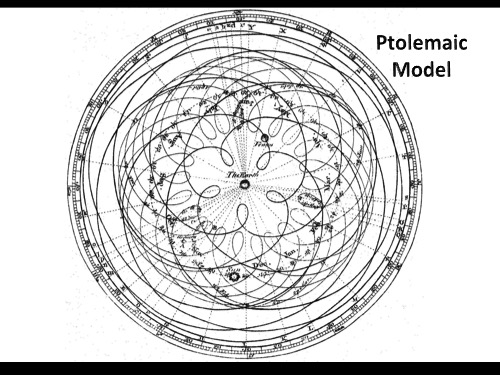
And again, I suggest another metaphor: The Ptolemaic model of the cosmos. Initially it seemed fairly simple. But the trouble is that it got more and more complex as people began to notice, for example, that some of the planets moved in retrograde motion from time to time. How do you explain that? There were certain curious phenomena that couldn’t be explained by the ordinary Ptolemaic system and so people kept invoking cycles, then epicycles. You know, the planet would be not just a dot going in an orbit around the earth but then there would be a center dot but the planet was orbiting that dot and going around. That would explain some things. And then it would be a little orbit going around a dot that was on a dot going around the dot going around the earth, and it got to be ridiculous.

If you look at some of the late attempts to salvage the Ptolemaic model or a modified form of the Ptolemaic model to engage in what was called then “saving the appearances,” it gets to be extraordinarily complex. The last great Ptolemaic astronomer was a truly great astronomer. You may have seen his name, Tycho Brahe. He was a Danish astronomer, the foremost, the master of all of the astronomical data of his day, right about the time of Galileo, and so he didn’t accept the Copernican model. He just kept adding epicycles.

Now if you pressed them they would tell you, “This isn’t really how it works. We don’t know how it really works. This is just a kind of a mathematical, geometric model for how it could be made to work and account for the data we’re seeing.

But he held onto it. And one of the reasons he held onto it is that actually the Copernican model didn’t account for the data fully. We look at Copernicus now and we say, “What a genius. You know, he simplified everything. He got it right.” Well if you look at his actual model, it’s concentric circles around the sun. That doesn’t work. The heliocentric model of the solar system didn’t work really until Kepler came up with elliptical orbits. That actually made it work. And then it’s elegantly simple and everything.

But Copernicus’s system was actually less adequate at representing the data that people like Tycho Brahe had gathered than that weird Copernican model that he had done. Nevertheless, people abandoned the Ptolemaic model with Copernicus because the simplicity of it appealed to them. It had just gotten so complex, it was just unbelievable that it was this complex. Now I know there are critics who say, “Those desperate Mormon apologists are constructing cycles on epicycles and so on. Well I can speak for one: That’s not how I see it. And I actually see some of the attempts to explain the Book of Mormon as being so complex and so ad hoc that they really just, they’re not satisfying. There’s a certain, in science and history and so on, there’s a certain room for aesthetics. Mathematicians talk about it a lot. That, you know, you come to a solution of a mathematical problem, and it just is beautiful. It’s elegant. It’s simple.

That’s true in physics. If you talk to really cutting-edge, theoretical physicists, they will tell you quite often that at first there may not be data there, but they just know it’s true because the mathematics is so beautiful. It’s just so good. And so they wait for the data to come along to flesh it out.

Well I want to suggest something like that in this case, that to me, the explanation of Joseph Smith is simple and elegant, and the alternative explanations just don’t work and they get more and more complex and it’s just too much for me, and so I’ve said sometimes that I simply don’t have the faith to disbelieve Joseph Smith’s story. I just can’t get there. I can’t do it. And I’ve tried. I’ve really tried to give it a serious look. I cannot put together hallucinatory explanations of the witnesses and stealing from Solomon Spaulding and stealing from Ethan Smith, and I’m just mentioning a few, and putting it all together. Joseph Smith, this incredibly learned young man who’s sitting there on the frontier.

Some of you may have seen Jeff Lindsay’s satire of this, “Joseph Smith, Translator Extraordinaire.”[1] It’s a wonderful piece. It has Joseph Smith sitting there writing the Book of Mormon, and people are constantly bringing in sources for him: Sidney Rigdon, Oliver Cowdery, Parley Pratt. Sidney Rigdon’s bringing in wheelbarrows of stuff for him to read. And at one point he finds a line in Walt Whitman’s “Leaves of Grass” that will give Joseph a really good line for the Book of Mormon. And Joseph says, “But Sidney, this book won’t even be written for another 35 years.” In response to which, Sidney Rigdon says, “Well, you’re pretending to be a prophet, aren’t you? I mean, come on, get with the program.”

All right. So … there’s a phone going off up here. I don’t know what that’s about, but I missed the call. It’s not my phone either.

All right, so let’s get with this.

Slide04

These are the logical options as I see them: That Joseph either had plates or he didn’t have plates. And then there are subdivisions that you can follow through to see possible ways in which each of these might be the case.

I remember my friend Bill Hamblin once being in communication with a one-time, fairly prominent, ex-member critic of the Church and of the Book of Mormon. And he said, “Look, let’s assume for a moment that you’re right and that Joseph Smith did not have plates. Did he know that he didn’t have plates or did he think that he had the plates? In other words, was he a conscious deceiver, or was he in some sense mad?”

To which this critic responded: “I don’t have to lower myself to your simplistic little dichotomies.”

Well, see, I think it’s intellectually incumbent upon people like that to, come on, give us an answer to this. Otherwise it’s like guerrilla warfare. You attack and attack and attack, you always withdraw, you never defend territory. You never have to stake out your own explanation, which then will be subject to criticism and attack.

Well to me, that simple-minded little dichotomy that this person refused to give an answer to. or refused to take part in, is still a really important question. If Joseph Smith didn’t have the plates, did he know that he didn’t have plates, or did he think that he did?

OK, so let’s look a little more in detail: Joseph had no plates. This is what most critics say; there were none.

All right, the first option is that he knew that he had no plates. OK. Now, this runs into a number of issues. You have to ask first of all, Was this deliberate, was it cynical or was it pious? Was he a cynical fraud, just a con-artist, 19th century con man?

I think you run into issues right there. One of the places you run into issues is with Joseph Smith’s writings, which are now being published, the personal writings of Joseph Smith, the Joseph Smith Papers. If Joseph Smith is not sincere, then I can’t judge sincerity in another human being.

This is a man who in his most personal private writings, letters to his wife, personal journal entries, they’re full of prayers. He’s praying all the time. Oh, Lord, help your servant, help me. Writing to his wife, Emma, praying, expressing prayers for her. Telling his children to be sure they say their prayers at night, this sort of thing. All the time coming across as a believer. There’s nothing, certainly there’s nothing at all in the early Joseph Smith that you could say points to someone who’s a cynical, manipulative deceiver. It’s just not there. He doesn’t let the mask fall at all. If he is one, there’s no evidence for it that I can see.

Now I know some people will come back and they will say what about plural marriage later on? Well that’s a difficult case. And we can argue that. I’m willing to argue that. I don’t want to do it here. That’s quite far afield. But I’m talking about the early Joseph Smith. I don’t think you see the cynical deceiver anywhere in Joseph’s character. But you certainly don’t see it in 1828. You don’t see it in 1830. This is a young man, I mean, you even have descriptions of him going out into the woods to pray, just as he says he did with the First Vision. This was a habit of his. He would go out into the woods to pray when he was concerned about something, when he was worried, when he was upset or indecisive and so on. There’s a continual pattern of this kind of thing. He is a believer. If you can see anything from the writings that are coming out, he really believes that he’s receiving revelations. He’s not a cynical con artist.

And there’s other evidence. Would a cynical con artist have put up with some of the stuff he endured?

Think of Liberty Jail. If you’ve ever been in Liberty Jail, you know how small that area was and how grim and dark it was. I had the occasion, the privilege a couple of years ago, I guess, to go back and speak in Liberty Jail. I never thought I would have that chance. It was for the anniversary of the building of the visitors center, I think. And I stood actually above the space in which Joseph Smith was confined. And what really worried me was I noticed they put the podium in such a place that I was standing on the trap door. And I just wondered, you know, if the talk goes on too long or they don’t like it, does it just open up, woosh, I’m down there with Joseph and Sidney.

But he was genuinely miserable. I think you have to understand that he came close to despair. You can imagine what it must have been like for him there. When he was writing this epistle, the famous epistle in Section 121: “O Lord, where art thou?”, I don’t think you should see that as just literary flourish or play acting. He really is feeling abandoned. This is a terrible time for him.

And it’s made all the more terrible by the fact that, well, I’ve got ahead of myself, by the fact that the saints are being driven out and he’s not able to do anything about it. Can you imagine? If you had any trace of human conscience at all, if you were lying, this would be almost impossible to endure. And he would have reached his absolute low point, but he comes through it faith intact, as does his brother Hyrum, one of the witnesses, so on and so forth.

Think of what else happened to the saints because of his claims. Can you imagine, again, if you were just making up a story and there were people literally dying for you, for this story you’re telling, gosh, you would have to be a sociopath to be able to put up with that, but there’s, again, no evidence that he was anything of the kind.

And then, of course, there’s his own ultimate martyrdom. He actually thought he was going to die at Liberty, but he did die just a few years later. And he pretty well knew that that was going to be the end result. Richard Anderson published an article years ago,[2] which didn’t get wide circulation, showing Joseph’s awareness of the fact that after about 1838-1839, that he was going to die fairly shortly, that there had been a kind of divine protection over him but he sensed that that had been, or would be shortly, removed, that his work was drawing to its end.

Now it’s easy to sit here and say, well, a con artist might go through it all to the end, but not many would. Again this argues for sincerity rather than cynicism and conscious deceit. He does actually die there and he dies faithful to his testimony. So does Hyrum Smith, and that’s striking to me. That Hyrum, the elder brother, accompanies him to Carthage Jail.

And, of course, there’s also the evidence that even if you decide that Joseph is a conscious deceiver, there are other people who are seeing thing with him. Most of his revelatory experiences are shared. After the First Vision, over and over and over again there are other people there who see things, heft things with him.

So the cynical deception thing just doesn’t cut it. It doesn’t do it.

Slide15

Here’s one of my favorite stories – that’s Mary Musselman Whitmer, who is one of the witnesses to the plates, the 12th or 13th witness, she’s been called. And her story is a remarkable one. We have at least two chains of accounts telling about her experience of having seen the plates, which she didn’t expect to do. And it was under very prosaic circumstances. Some people have told me, and I’ve mentioned this here before, oh yeah, the witnesses were just in some sort of religious ecstasy, right? They hallucinated this. She’s milking the cows.

And I didn’t grow up on a farm but my father did. And he told me that milking cows was not a mystical experience for him. In fact, I’ll just mention, my father was convinced – he grew up in a Lutheran family in North Dakota – he was convinced that he was going to hell because, he said, you couldn’t milk cows without swearing. Because just as you got the milk pail filled, the cow would stick its filthy hoof in the milk or the cow would hit you in the face with its filthy tail, he said. And he would spend time sometimes with his city cousins, and he said they’re going to heaven because they don’t have to milk cows, and I’m going to hell because I do. It’s not fair. It raises the problem of divine justice and the problem of evil in a really acute form, you know, if you’ve been raised on a farm and you have to put up with that.

She’s out there milking the cows and she’s not in a good mood because the menfolk are in there translating the Book of Mormon, and she’s having to do all the work and feed them. So she’s not feeling especially spiritual. That’s when the messenger comes and says, look, you’re having a hard time, right? It’s only fair that you get a special look at these plates so you will feel better about things. And she did. She felt considerably better.

But, again, how would Joseph Smith, the cynical deceiver, explain that?

Then you’ve got to bring in something else. All these people are hallucinating, right? Mary Whitmer, while milking the cows, hallucinates the plates. Oh it’s possible, but good grief, it strains credulity just a little bit.

OK, so here’s another possibility: He wasn’t a cynical fraud but he was a fraud nonetheless. He was pious fraud.

This is a little harder to deal with because the evidence for his sincerity and piety are all over the place. So, but still nevertheless, maybe he had no plates, he just somehow convinced a bunch of other people that he did. But that’s, again, really hard to trust or to take seriously, because too many other people see these things.

Now I’ve gotten lectures within the past few days on, you know, the weaknesses of eyewitness testimony. And it’s true, sometimes eyewitness testimony is weak. For example, if somebody comes to you, you open the door and the person pulls a gun on you. Later on you may not be able to remember what color his shirt was, because you’re kind of focused on the gun that’s aimed at your face.

So eyewitness testimony can be unreliable. But for things like this we have multiple people saying we saw and took considerable amount of time, in some cases, in the case of the eight, we hefted, we felt this in these plates, it seems to me you’re really, really pushing it to say, well, you know, eyewitness testimony just isn’t reliable. In fact, I offered in a discussion I had the other day, I said, look, I’m just going to come over with a sledgehammer and demolish your car. You can come out and watch. And my defense will be, eyewitness testimony is unreliable. How does he know he actually saw that? It’s notoriously unreliable. So even though I stood there for 20 minutes with a sledgehammer and pounded his car in, that doesn’t count for anything.

We take eyewitness testimony seriously all the time unless we have strong reason to reject it. My argument is, these people do have strong reason to reject it, but it’s not a good reason. They just don’t want to believe it. So these witnesses alone among witnesses who have experiences with hefty material objects and so on, they become totally unreliable, not worth taking seriously at all.

So the pious fraud thing doesn’t work. Pious he was. But the fraudulent thing – that he had no plates, and knew that he had no plates – doesn’t stand up for those reasons and others.

Slide17

So, you know, you have to get in a Simpsons reference. I think my children were educated more by the Simpsons than by school. So there you have the pious fraud, or another one.

Slide18

But maybe he thought he had plates. Maybe he was nuts. Maybe in some sense he was a dissociative personality, he didn’t know what was real around him and so on. Well where is the evidence for that?

Joseph seems to be pretty much in touch with reality. But even so, again, you run into problems.

Suppose you say, all right, Joseph was hallucinating the plates. What about all the other people? Did he really manage to find the eight local yokels who would also hallucinate plates just in time? I mean it’s … I don’t know how you even pull this off. You’ve got the eight witnesses, you’ve got the three, you’ve got multiple other witnesses I’ve mentioned before. Some of my favorites are the people who spend time with the plates when Joseph isn’t around – Emma and his sister Katherine feeling the plates, you know, feeling the D-shaped rings that hold them together, ruffling along the edges, you know, and having the top plate scrape across the one below. Again, you can say all you want: Joseph thought he had plates, he was just mentally ill, but then you’ve got a whole bunch of other people and they seem to be densely concentrated around the area where Joseph lives – something in the water that they all imagine plates all at the same time. It’s remarkable. That’s almost a sign of divine intervention right there, that you have such luck to find so many crazy people so densely concentrated and available to him.

All right, so the alternative is: Joseph had plates. He didn’t have no plates, he had plates. And here are the possibilities as I see them:

Maybe he made them. Well, all right, yeah, he made them.

All right, now you have to come up with evidence that Joseph was able to make plates. What evidence is there that he was a metallurgist or a blacksmith or anything of the kind that he could make plates? Well, there is no evidence and so there was a time when people were arguing that it was actually Oliver Cowdery who had blacksmithing experience. Now if you’ve read Longfellow’s old poem[3] about the blacksmith with broad and sinewy arms, you know, his mighty massive chest and all this sort of thing, that’s not Oliver Cowdery. He was a very slight man and he died very young of something like tuberculosis. He was not a powerful, muscled guy. And there is no evidence whatsoever that he was a blacksmith.

But trying to invoke him as a blacksmith is already an admission that Joseph Smith making the plates doesn’t really work; it doesn’t really hold up.

Now there are people who have still suggested it. Dan Vogel has suggested recently or relatively recently, and a lot of people have picked up on this. There’s no evidence for it. Where do you get that much gold? Do you realize how much gold that would be? We’re talking about thousands and thousands of dollars, maybe hundreds of thousands of dollars’ worth of gold in today’s prices. I don’t know what gold is today; I haven’t looked. But the plates are generally estimated at about 60 pounds. Even if they’re gold alloy, that’s a lot of gold. How many of you have that, you know?

And then it disappears, right? The family had this enormously valuable artifact and then they lost it or something? And they continued to live in poverty? It’s really rather strange.

Where did the Smiths get the money to get that much gold? There’s a line from Martin Harris that I’ve quoted before, I really enjoy it, where at one point before he’s an official witness Martin actually sits with the little wooden box that the plates were in on his lap and he was struck by how heavy it was, because it was heavier than a rock would have been or if it had been filled with dirt. You know how gold is unusually heavy, gold and lead both. And so Martin Harris’s remark afterward is that it was heavy enough that he knew it had to be either gold or lead and he knew that Joseph had not enough credit to buy so much lead. I don’t know if he meant that to be funny or not, but I think it’s funny. Because, well, if it’s not lead then obviously Joseph went out and got the cheaper stuff, gold.

But he has a material object of considerable heft and it’s difficult to explain that and it’s difficult to imagine that he made plates that would gull the yokels. You have to imagine this. Again, I go back to Jeff Lindsay, who, I think it’s Jeff Lindsay. Or maybe I’ve written on this, I can’t remember. Maybe I’m losing my mind. But the idea that you have this sort of specialty forge to the south of Palmyra where gold is coming in pound after pound after pound and Joseph and Oliver are there pounding out these plates and creating … remember there are other artifacts – the Liahona, the breastplate, the sword of Laban, all this sort of stuff. They’re absolutely first-rate metalworkers. And nobody in Palmyra notices the smoke belching out of this place and the daily deliveries of gold ore? A little strange. There were no secrets in a place like that and so it’s hard to imagine that.

So both the cynical fraud and the pious fraud sort of go out of the way there and the evidence that he made them is nil.

So what about, he received them from somebody else? Well, two possibilities: he received them from a contemporary or from a non-contemporary.

Slide27

Now, years ago I had a fellow who was arguing for a thesis of an unknown conspiracy that had created the plates … the Book of Mormon, rather, not the plates; he didn’t think there were any plates. But this group had created the Book of Mormon at some time. I asked him if he could specify the time. No he couldn’t; it could have been any time within the previous three hundred years. Was there any particular place that they had done it? No he didn’t know that. I said, well, you know, of course you don’t because there’s no evidence for this. You’re just making this up. I called them the Illuminati. Because it’s the idea that there is a conspiracy out there that is so secret that there is no evidence for it at all. We don’t who they are. We don’t know when they did it. We don’t know why they did it. We don’t know how they did it, why they chose Joseph Smith, nothing. You just assume they’re out there. This is a case of being thesis-driven to the point of absurdity, that you need somebody else to do it because you know Joseph Smith didn’t do it, so some mythical person did it, or persons. How many? He didn’t know.

Slide28

Anyway, it, to me, is on the level of Harvey the invisible rabbit. Although in Harvey it turned out there was one. I’m not expecting to find the Illuminati any time soon.

So there’s no evidence for contemporaries. We just don’t have any evidence for the plates coming from anybody else.

Maybe he received them from a non-contemporary.

Slide30

Well I have a candidate.

What I would argue here, see, I’m just kind of going through this very rapidly, but I would argue that I put this last because I think every other avenue has been blocked off. You can’t do it. And so it leaves you with the one explanation that’s still out there.

Now I know for some people this is impossible too. But you may remember the line from Sherlock Holmes where he explained his method of deduction. Which was simply, you have to eliminate all the things that are impossible and whatever you are left with, however improbable, must be the explanation.

Now there are people out there saying, “no, no, no, you don’t get books from angels”, to quote Sterling McMurrin. He already had a predetermined dogmatic position, so it couldn’t be that way. Or, what’s his name, Morgan, Dale Morgan, who said, look, I can accept any explanation except the one the Church gives. Well, if that’s your position, then fine. This avenue is blocked off for you too. So you have to go with another. Like the Illuminati. That will do. Because that’s more probable if you’re absolutely, resolutely opposed to the idea that an angel could have delivered the book to Joseph Smith, that’s what you’re left with.

But for those who allow for what William James called “live options,” that this could be true, then it seems to me that ultimately, in a sense, people are forced, should be forced, to this conclusion.

Now, I realize there are enough ambiguities out there, I’m oversimplifying, that not everybody will get to this position. But it’s the way I get there. It’s why I can’t take those other avenues. I’ve said, I can’t not believe, because, to me, Joseph Smith’s story is easier to credit than the explanations that have been proposed to account alternatively for what he claimed.

And there are other things, I mean, I haven’t gotten into these things, but the plausibility of Lehi’s trip down the coast of Arabia and then over from Nahom to the Indian Ocean or the Arabian Sea. These things strike me as remarkable. And they shouldn’t be there if Joseph Smith were the shallow fraud that many claim him to be.

We pointed this out before – the existence of the Nahom altar piece in exactly the right place dating to exactly the right time, indicating that name NHM was there.

There you have the Indian Ocean sea coast where you’ve got a place that actually looks, by the standards of Arabia, believe me, Bountiful. How many of you have been to Saudi Arabia? It makes the area around Las Vegas look like a tropical rainforest.

I’ve always loved the weather reports when I’m in Europe, you know, they will do worldwide weather reports and they announce the weather today in the Arabian Peninsula is hot and dry. Yeah.

There are new world correlations that to me are extraordinarily interesting. I’m just going to zip through these.

You have the testimony of people like Emma Smith about her husband’s incapacity to dictate or to write even a good letter.

You have the evidence that was alluded to already in this conference. I’m not going to propose William Tyndale as the ghost author or the head of the committee or anything like that, but you have this Early Modern English, which to me is striking because it just seems to me so unlikely that Joseph could have made that up. Now maybe that is evidence for the Illuminati. Heck, if you don’t know who they were or where they were or when they were, maybe they were Early Modern English speakers.

But it would be the only evidence that I know of. But, again, it’s a very difficult thing to explain naturalistically about the Book of Mormon, that it has this very curious language in it which doesn’t seem to be Joseph Smith’s hick upstate New York language. It doesn’t seem to be necessarily the language of the King James Bible. It seems to have another source. Well, again, that points to a non-contemporary source for the Book of Mormon.

You have chiasmus. We’ve heard that discussed here already and of course it’s one of the more famous bits of evidence for the Book of Mormon textually.

I just want to say that … yeah, I have gone overtime anyway. I was trying not to. I just want to say, to me, I’ve been very, very simple here. We could discuss this for hours; we could discuss it for days. But to me the alternative explanations, which I think I’ve summarized here, they’re the only ones that are really on offer, they simply don’t work.

Now you can say, well, Joseph’s doesn’t work either, and, OK, if your dogmatic stance is there is no supernatural, there are no such books, God doesn’t deliver books to people, there is no God, well then, yeah, I understand you have a problem with this. But then I think you should have a problem with this. That’s partly what the challenge of the Book of Mormon is. That it presents you with a hard artifact.

If it were just Joseph Smith imagining that he saw God, or something like that, that would be one thing, but in the case of the Book of Mormon, you have a tangible object. In fact, in the early 19th Century you had a very heavy tangible object – the plates – which demands an explanation. And I don’t see any good alternative explanations on display anywhere. And so if someone wanted to ask me, what are the best arguments for the Book of Mormon, I would say one of them is simply that you guys can’t come up with a good counter-explanation.

You can’t explain it. You might be able to explain hypothetically, this or that aspect of it. But you can’t explain the whole thing, and parts of it are simply beyond your power to explain. So the standard response to the witnesses is to dismiss them. The standard response now is to say, well, they never actually saw anything. But they did and, you know, I’m repeating myself because it needs to be repeated. I’m hearing more and more often people who just say, well, they never actually claimed to touch any solid object. Oh yes they did. You’re just ignoring what they say.

Richard Bushman interestingly says in the case of early Mormonism it’s the critics not the Mormons who have to dispose of the early primary sources, the historical documents. You have to just get rid of them, because you have the witnesses saying, “Look, I held them.”

And then they say, well, they never actually claimed to touch them. Yes, Hyrum Smith says, I held them with these hands. Can he be any more clear?

Well, he didn’t really see them with his real eyes. He says, I saw them with these eyes. I don’t know what else he can say.

I remember a person on my mission who demanded to know whether there was any evidence for baptism for the dead in the Bible and so we, of course, opened up to 1 Corinthians 15:29, which he said wasn’t there. I said, “read it again.” “No, it’s not talking about baptism for the dead. It doesn’t even mention baptism for the dead.” We went over this for about five minutes. I was incredulous and finally I said, look, OK, I think were done. I mean if I can’t get you to … I mean, he read it aloud. And still wouldn’t say it mentioned anything about baptism for the dead. OK, fine, but when I run into people like that I don’t know what to do.

There are people who simply will not see. If you tell them about the witnesses, the witnesses say I saw with these eyes, I hefted with these hands, I saw them, I know what I’m talking about, then they say. well, they really didn’t claim to see them.

I have no idea what to do. Just move on to the next person.

But for a person who’s open-minded, it seems to me the challenge the Book of Mormon makes is remarkable. Because it hits you right between the eyes just as, in a sense, the resurrection of Christ does. The tomb is empty, right? That would be a whole other talk. The tomb was empty. Everybody admits the tomb was empty. The Jews in Matthew admit it. The Mishnah admits it. Everybody admits it. Counter-explanation is that the disciples stole the body then hatched this amazingly brilliant plot to found a new world religion and get themselves crucified.

But everyone admits that basic fact, that a few days after the crucifixion he wasn’t there. That’s irreducible. No one really disputes it, in antiquity or, for the most part, today, I don’t know anyone does. Even critics, even atheists, say, yeah, it was empty, probably because the body had been stolen or the body had been thrown to the dogs or something like that.

But there are certain irreducible facts, and one of the irreducible facts is the Book of Mormon is real, that it exists, this early 19th Century farm boy with very little education produced this amazing book, very complex book, which we’re still talking about today. And that there were people who claimed to see objects, and not just a few, a lot of them. It’s not just the 11 witnesses; it’s several more who claim to see and heft objects connected with it, objects which can have no other explanation, it seems to me, no plausible explanation other than they were delivered to Joseph in the way he said they were. And that’s really hard.

Then I close with a comment from a good friend of mine years ago who left the church, years ago. But he said to me at one point, well, Joseph didn’t even claim necessarily to translate when the plates were there. So what’s the purpose of the plates? And I said, well, they’re an absolutely indigestible lump in the throat of people like you. That’s what they’re there for. Because you can’t explain them away. And they should give you pause. You ought to think about this and what it implies. Whatever else you may think about Mormon theology or our stance on gay marriage or the families of gays or our views of patriarchy and so on, there were plates. Where did they come from?

And an image that I’ve cited many times before and I will do it again, and then close, you have the story of Madame du Deffand in France who is taken to the site of where Saint Denis or Saint Dionysius supposedly was beheaded. And then, he had insisted he didn’t want to be buried at that spot, so after his beheading he picked up his head and walked with it about a thousand meters away and put his head down where he wanted his shrine to be. And the person who’s telling her the story says, “Isn’t that a ridiculous story, can you believe he walked a thousand meters?” And her response is, “Well, I would think if you grant the first step, the distance is just details.”

Well, to me, it’s that Book of Mormon, those plates, the testimonies of the witnesses and so on, the presence of a tangible object right at the beginning, the rest is details, in a way. If you grant that, you’re stuck. Or you can refuse to grant it. But then you may still be stuck in a more serious and eternal way.

I bear you my testimony the Book of Mormon is true, that it really is what it claims to be and the presence of that physical object in much the same way that the physical resurrection of Christ does, establishes its truth, that God actually intervened in this world, did something measurable, tangible, demonstrable and visible. We’re not left to just guess or follow Saint Thomas’s five ways to try to demonstrate that God exists. He left his fingerprint on something. He made it very clear and that is really, really important, and because of that, all that is done here at FAIR and all the work we do in the Church, all the building of temples and so on, all of this is justified, because there is a God, he cares about us, he intervenes in this world.

I bear you my testimony that’s true in the name of Jesus Christ, amen.

Q&A

Thank you. I have two questions. The first is:

Question: Have you read Ann Taves’ paper[4] on Joseph Smith and the plates?

Answer: I read one that appeared in the Mormon … what’s it called … Mormon Studies Review, that one. I used to have a connection with that.

Q: If so, can you comment on her approach?

A: She wants to have a way where there were no plates, but Joseph Smith was neither mad nor a deceiver. I can’t imagine such a way. I can say the words. I can say that there’s a 365-degree circle too, but it doesn’t mean there is one. I can talk about a 270-degree triangle or a place in which two plus two means five, but it doesn’t make any sense. It’s literally gibberish, and so I don’t know what to make of that.

Q: What evidence would you give against Oliver Cowdery helping with the creation of the Book of Mormon? Some say he had a history with Ethan Smith as his pastor.

A: We could go into this at some great length. There has been some very good stuff done on this. There’s an entire volume published on Oliver Cowdery by BYU Studies some time back that looked at this question. I think there’s essentially no evidence of a connection between Oliver Cowdery and Ethan Smith and, you know, again, Oliver Cowdery, what motive would he have? He bears his testimony to his dying day, literally, when he’s on his deathbed, the Book of Mormon is true. I just don’t see a motive for it. There’s no evidence he was there helping out. He seems to have been as surprised as Joseph was by what’s coming forth. He knows nothing about it in advance. The evidence is that it really was dictated to him, that the original manuscript – we have the premier authority [Royal Skousen] here – the original manuscript, am I right in saying that it shows all the signs of having been dictated, with the aural errors? And then the publisher’s manuscript is copied with copyist’s errors in it. So everything fits the story that Oliver tells. There’s no evidence that he just writes it out, that he and Joseph make it up. He’s receiving dictation as he said he was. He bears his testimony to his dying day, including when he knows he’s dying. I see no evidence whatever that he’s being deceptive here. He spends time out of the Church, but he remains faithful to his testimony of the Book of Mormon, when it was not a very fashionable thing to be a Mormon. And yet he does. So I’d say, What evidence would I give against Oliver Cowdery helping with the creation of the Book of Mormon? I’d ask, What evidence do you have for it? I mean, come up with the evidence, we’ll see what it is, but I see no evidence for it at all.

Thank you very much.

Notes

[1] Jeff Lindsay, A Day in the Life of Joseph Smith, Translator Extraordinaire (2003), available at http://www.jefflindsay.com/oneday.shtml.

[2] Richard Lloyd Anderson, “Joseph Smith’s Prophecies of Martyrdom,” in A Sesquicentennial Look at Church History: Sidney B. Sperry Symposium, January 26, 1980 (Religious Instruction, BYU, 1980), 1–14.

[3] Henry Wadsworth Longfellow, The Village Blacksmithavailable at http://www.hwlongfellow.org/poems_poem.php?pid=38.

[4] See Mormon Studies in the Academy: A Conversation between Ann Taves and Spencer Fluhman, in Mormon Studies Review 1 (2014), available at http://www.academia.edu/10736844/Mormon_Studies_Review_1_2014_

Wednesday, May 1, 2024

Focus on God, not Earthly/Carnal Desires

Loved the Follow Him Podcast for Enos - Words of Mormon with Gerrit Dirkmaat Part 1 and Part 2shownotes here

One part that I really loved, the story of Joseph trying to pay for the printing of the Book of Mormon (Part 2 minute 14) being worried with carnal desires (Doctrine & Covenants 3:4

"Joseph bought a farm in Harmony that was almost 14 acres with a farmhouse on it, and apparently some other outbuildings and a well, the trees are already cut down on a lot of it, so it's already farmable. He buys that 14-acre farm and house for $200. The cost of printing the Book of Mormon is 15 times Joseph Smith's entire net worth if he did own his home, which he doesn't, because he can't make the payments on his own home. To put that in our perspective today, the Lord is essentially saying that you need to come up with, in a lump sum, 15, 16, 17 times the amount of money you make annually. That seems impossible. To me, it's impossible. I would have to have an angel come to tell me to believe that I could do that."

Continuing in Part 2 skipping ahead to minute 23:30 - "He goes on to chastise Joseph pretty severely. Because Joseph had made this covenant and he'd broken it. And why had Joseph broken it? In Joseph's world, he couldn't possibly see any way that he could maintain the publication of the Book of Mormon without Martin Harris. That is impossible. And it's not like I've got people falling off the back of milk wagons everywhere believing the things that I'm saying. No one is believing me. Outside of my own family, who have no money at all, no one believes me at all. No one. I have to do this for Martin or I won't even be able to do what God wants me to do. The Lord says, "For although a man may have many revelations and have power to do many mighty works, yet if he boasts in his own strength and sets at not the counsels of God," the counsels of God told him multiple times not to take them, "and he follows after the dictates of his own will and carnal desires," this is not a reference to Joseph carnally wanting something sinful. Carnal as in earthly. Your focus was, how could I possibly pay for this? I understand why you have that focus, and as God, I told you not to have that focus. Carnal desires. “He must fall and incur the vengeance of a just God upon you. Behold, you have been entrusted with these things, but how strict were your commandments; remember also the promises that you've made: that if you did not transgress them," and then probably the biggest stinger, "Behold, how oft have you transgressed the commandments and laws of God and have gone on in the persuasions of men?" Boy, at this point in Joseph's life, it took him four years to get the plates because he just couldn't overcome all of the pressures of the world around him; and then he finally gets them and those pressures of the world are still there. Verse seven: "For behold, you should not have feared man more than God. You should have been faithful, and He would have extended His arm and supported you against all the fiery darts of the adversary, and He would have been with you in that time of trouble." So after this pretty severe chastisement, again, Joseph's still probably thinking that his soul was lost, has the Lord say to him in verse 10, "But remember, God is merciful. Repent of that which thou hast done, which is contrary to the commandment which I gave unto you, and thou art still chosen, and thou art called to the work," where Joseph learns from the mouth of the Lord he is not cast off forever. Even though he has made an enormous transgression, even though it seems the entire work of the translation of the Book of Mormon is ended and it's over and the Restoration comes to a full stop because of Joseph's actions, God is merciful."

With Corey's business, he feels sometimes like maybe he's messed up and doubts himself, that maybe he has not heard what the Lord was counseling him to do, but even if that is the case, like it was for Joseph Smith, God is merciful and God can still provide a way for us to accomplish what He has called us to do. We can trust him to help us! God is able. We are to NOT FEAR, to go forward with faith like the children of Israel, and to show our faith by being patient. We don't want the Lord to chastise us after he calms the storm and ask "Why are ye so fearful? Where is your faith?" Be calm in the storms of life and TRUST.

Also I loved Part 2 38:38 - Gerrit's answer begins on how to get to the point where life can't shake your faith - I especially liked minute 43

"The way to make faith unshaken is to focus like a laser on the Holy Spirit testifying to you that Jesus is the Christ and that Joseph Smith saw God. The way to have your faith shaken is to allow details of how God unfolds his plan to become more important than God's plan. People get shaken because I don't know, I was doing my family history and I saw that my great great-grandmother, she was married to three different men in her life, when we went to the temple I mean we sealed her to all three of those men, but I mean of course she can't be married to all three of them in the next life, so which one do you think she's actually married to? It just seems weird that we don't really know, but I found her journal and it says that she really loved her second husband more. I think that's the one. We whip ourselves into a frenzy desperately trying to figure out exactly how God is going to make everything right to the point where say on the question of sealings or marriages, people might even lose their testimonies because they can't figure out how sealings work. And the great tragedy of that is the only reason why you even have a question about who's married to who in the next life is because Joseph Smith is a prophet. The moment Joseph Smith stops being a prophet, you don't have to ask that question anymore because the answer is NOBODY, because marriage doesn't exist in the next life for any other Christian faith. Why do we believe it exists? We believe it exists because Joseph Smith's a prophet."

Some may lose faith in the church and it's teachings of the importance of temple worthiness or chastity, and doubt that a loving God would NOT allow them to be with their family forever. Family members that are LGBT or even if some of the family members are not keeping commandments or have lost faith in God, but I hope that they don't abandon Joseph Smith and the Restored Gospel over those doubts, but instead realize that the ONLY reason they HAVE a belief that in Eternal families is, like Gerrit teaches here, IS BECAUSE JOSEPH SMITH TAUGHT US THAT PRINCIPLE! If Joseph Smith isn't a prophet, then NOBODY is going to be with their family in the next life anyway, cause marriage doesn't exist. And maybe then they want to say God must not exist and they just abandon it all, and I guess that's their right to choose that option. But I am grateful to believe with ALL MY HEART in Eternal Families, in Temple covenants, in Joseph Smith, and in the MIRACLE of the Book of Mormon and it's glorious teachings of Jesus Christ and his doctrine. 

Thursday, March 28, 2024

Truth

I have really loved reading the Book of Mormon this year. I have been doing it most consistently at the kitchen table between 5-7 am.

I like that I'm able to put my books and pencils in the bench. Although most days I just leave it out all day. I have been waking up pretty consistently at 5:15, so I'll read as I make oatmeal, and will read from 6-7 if I'm taking carpool at 7, or after I get home at 7:15 if I go climbing at 6. I have caught up and am in Jacob now, ahead of schedule.

Some of my margin notes this morning, scriptures pointed out to me from the book "True Versus Truth". I want to chase darkness from my life!
Related Posts Plugin for WordPress, Blogger...