It is good to be here with you this morning, my dear young friends. I ask that the Lord will help me to say something that will help you.
Recently I spent the better part of a week in Washington, D.C., living in a hotel room. Each morning I watched the early news on television and then read the morning paper while eating breakfast. President Ford had just granted a pardon to his predecessor. The amount of venom that spewed from the mouths and pens of the commentators was unbelievable. They were aflame with indignation. In all that week of morning watching and reading I never heard nor read among the commentators and editorialists a single paragraph of positive thought. The speakers were brilliant. They were men of incisive language, scintillating in expression. The columnists were masters of the written word. With studied art they poured out the sour vinegar of invective and anger, judging as if all wisdom belonged to them. At the conclusion of that week, I too made a negative observation. Said I, “Surely this is the age and place of the gifted pickle sucker.”
The tragedy is that this spirit is epidemic. Criticism, fault-finding, evil speaking—these are of the spirit of the day. They are in our national life. To hear tell these days, there is nowhere a man of integrity among those holding political office. In many instances this spirit has become the very atmosphere of university campuses. The snide remark, the sarcastic gibe, the cutting down of associates—these, too often, are of the essence of our conversation. In our homes wives weep and children finally give up under the barrage of criticism leveled by husbands and fathers. Criticism is the forerunner of divorce, the cultivator of rebellion, sometimes a catalyst that leads to failure. Even in the Church it sows the seed of inactivity and finally apostasy.
I come this morning with a plea that we stop seeking out the storms and enjoy more fully the sunlight. I am suggesting that we “accentuate the positive.” I am asking that we look a little deeper for the good, that we still our voices of insult and sarcasm, that we more generously compliment virtue and effort. I am not asking that all criticism be silenced. Growth comes of correction. Strength comes of repentance. Wise is the man who can acknowledge mistakes pointed out by others and change his course. I am not suggesting that our conversation be all honey and blossoms. Clever expression that is sincere and honest is a skill to be sought and cultivated.
What I am suggesting and asking is that we turn from the negativism that so permeates our society and look for the remarkable good in the land and times in which we live, that we speak of one another’s virtues more than we speak of one another’s faults, that optimism replace pessimism, that our faith exceed our fears.
When I was a boy our father often said to us:
Cynics do not contribute.Skeptics do not create.Doubters do not achieve.Challenges to Our Political System I should like to say a few words about America. I know that there are many here who come from other lands. I think I have been in all of the lands from which you come. I appreciate your people, their innate goodness, their art, their industry, their strength. I have marveled at the beauty of the earth, the wonder and magnificence of God’s creations, as I have seen them in every part of the world. No land is without its beauty, no people without their virtues, and I hope that you who come from elsewhere will pardon my saying a few words concerning my own native land, America. I know that she has problems. We have heard so much of them for so long. But surely this is a good land, a choice land, a chosen land. To me it is a miracle, a creation of the Almighty. It was born of travail. The Constitution under which we live is the keystone of our nation. It was inspired of God. Of it, the great Gladstone said, “As the British Constitution is the most subtle organism which has proceeded from progressive history, so the American Constitution is the most wonderful work ever struck off at a give time by the brain and purpose of man” (“Kin Beyond the Sea,” North American Review, September 1878).
In a few months we shall celebrate the two hundredth anniversary of the founding of the nation. Is it not a miracle that through these two centuries of time our system of government has remained intact, our Constitution has held while storms have beaten about us from within and without?
There is too much fruitless, carping criticism of America. Perhaps the times are dark. There have been dark days in every nation. I should like to repeat the words of Winston Churchill spoken exactly thirty-three years ago today. Bombs were then dropping on London. The German juggernaut had overrun Austria, Czechoslovakia, France, Belgium, Holland, Norway, Russia. All of Europe was in the dread grasp of tyranny, and England was to be next. In that dangerous time, when the hearts of many were failing, this great Englishman said:
Do not let us speak of darker days; let us speak rather of sterner days. These are not dark days; these are great days—the greatest days our country has ever lived; and we must all thank God that we have been allowed, each of us according to our stations, to play a part in making these days memorable in the history of our race. [Address at Harrow School, 29 October 1941]
Earlier he had said to his people and to the whole world, following the catastrophe at Dunkirk when the prophets of doom foretold the end of Britain:
We shall not flag or fail. . . . We shall fight in France, we shall fight on the seas and oceans, we shall fight with growing confidence and growing strength in the air, we shall defend our island, whatever the cost may be, we shall fight on the beaches, we shall fight on the landing grounds, we shall fight in the fields and in the streets, we shall fight in the hills; we shall never surrender. [Speech on Dunkirk, House of Commons, 4 June 1940]
It was such talk as this, and not the critical faultfinding of glib cynics, that preserved the great people of Britain through those dark and deadly days when all the world thought their little island would go under.
It shall be so with America if we will do less speaking of her weaknesses and more of her goodness and strength and capacity. I was stirred in my heart by the words of our late, great President Harold B. Lee, who, speaking to a group such as this, said:
This nation, founded on principles laid down by men whom God raised up, will never fail. . . . I have faith in America. You and I must have faith in America if we understand the teachings of the gospel of Jesus Christ. [Deseret News, 27 October 1973]
I doubt not that we shall have days of trial. I am confident that so long as we have more politicians than statesmen, we shall have problems. But I am certain that if we will emphasize the greater good and turn our time and talents from vituperative criticism, from constantly looking for evil, and lift our sights to what may be done to build strength and goodness in our nation, America shall continue to go forward with the blessing of the Almighty and stand as an ensign of strength and peace and generosity to all the world.
Economic Challenges
We hear much talk of economic depression these days. Heaven forbid that we should ever slip again into the kind of monetary quagmire through which we struggled in the 1930s. Those were the days of the long soup lines, of suicides that came of discouragement, of a bleakness of life which few of you can understand. I hope and pray that such hard times will never come again. But I think it not impossible or even improbable if enough people, in the spirit of negativism and defeatism, talk about it and predict it. We are the creatures of our thinking. We can talk ourselves into defeat or we can talk ourselves into victory.
Likewise, it is so in the Church. We even have some who quibble and fret over little things, evidently totally unaware of the majestic destiny of this, the work of God.
When gold was discovered in California in January of 1848, men of the Mormon Battalion were there and participated in the discovery. Completing their contract, they came to the Salt Lake Valley to join their families. Some of them brought with them gold, and in the hard and desperate days that followed, particularly in the bitter winter if 1848–49, many wanted to go to California, where life was easier and gold was to be picked from the riverbeds. In that time of gloom, Brigham Young stood before the people in the old Bowery on Temple Square and said:
Some have asked me about going. I have told them that God has appointed this place for the gathering of his saints, and you will do better right here than you will by going to the gold mines. . . . We have been kicked out of the frying pan into the fire, out of the fire into the middle of the floor, and here we are and here we will stay. God has shown me that this is the spot to locate his people, and here is where they will prosper. . . . We shall build a city and a temple to the most high god in this place. We will extend our settlements to the east and west, to the north and south, and we will build towns and cities by the hundreds, and thousands of the saints will gather in from the nations of the earth. This will become the great highway of the nations. Kings and emperors and the noble and wise of the earth will visit us here, while the wicked and ungodly will envy us our comfortable homes and possessions. [Autobiography of James Brown, pp. 119–23, cited by Preston Nibley, Brigham Young, the Man and His Work (Salt Lake City: Deseret News Press, 1936), pp. 127–28]
What a remarkable statement under such circumstances!
My heart goes out to those who were cold and hungry that winter. I am sure there was much of grumbling and criticism, and understandably so. But how marvelous when a man looked beyond the winter and spoke as a prophet, under the power of the Holy Spirit, of better days to come.
Those days have come. Last year more people visited Temple Square in Salt Lake City than visited Yellowstone Park. This has become the great highway of the nations. Kings and emperors and the noble and wise of the earth constantly visit us here.
Brigham Young went on to say on that occasion:
It is our duty to preach the gospel, gather Israel, pay our tithing, and build temples. The worst fear that I have about this people is that they will get rich in this country, forget God and his people, wax fat, and kick themselves out of the Church and go to hell. This people will stand mobbing, robbing, poverty and all manner of persecution, and be true. It my greater fear for them is that they cannot stand wealth; and yet they have to be tried with riches, for they will become the richest people on this earth. [Nibley, Brigham Young, p. 128]
To which I can hear many of you say, “Hasten the day.”
I believe that day, spoken of by Brigham Young with a voice of prophecy that rose above the voices of defeat and criticism, has come. We have been blessed with the bounties of heaven and the bounties of earth. Oh, how magnificently and munificently we have been blessed! Now, with gratitude in our hearts, let us not dwell upon the few problems we have. Let us rather count our blessings and in a great spirit of gratitude, motivated by a great faith, go forth to build the kingdom of God in the earth.
Educational Challenges
Likewise, in our life on this campus, let us look for and cultivate the wonders of our opportunity, here to partake of learning, here to enjoy marvelous associations, here to develop great loyalties. It is so easy, under the pressure of the daily grind, to become negative and critical, to be shortsighted and go down in defeat. I have been touched by these words spoken by Benjamin Ide Wheeler, who at one time served as president of the University of California. Said he to a group of students:
This university shall be a family’s glorious old mother, by whose hearth you shall love to sit down. Love her. It does a man good to love noble things, to attach his life to noble allegiances. It is a good thing to love the Church, it is a good thing to love the State. It is a good thing to love one’s home, it is a good thing to be loyal to one’s father and mother. And, after the same sort, it is good to be loyal to the university, which stands in life for the purest things and the cleanest, loftiest ideals. Cheer for her; it will do your lungs good. Love her; it will do your heart and life good.
In your associations one with another, build and strengthen one another. “No man is an island; no man stands alone.” We so need help and encouragement and strength, one from another.
On one occasion when the Savior was walking among a crowd, a woman who had been long sick touched his garment. He perceived that strength had gone out of him. The strength that was his had strengthened her. So it may be with each of us. Let me urge you to desist from making cutting remarks one to another. Rather, cultivate the art of complimenting, of strengthening, of encouraging. What wonders we can accomplish when others have faith in us. No leader can long succeed in any society without the confidence of the people. It is so with us in our daily associations. Said the Lord to Peter, “Simon, Simon, behold Satan hath desired to have you, that he might sift you as wheat: But I have prayed for thee, that thy faith fail not: and when thou art converted, strengthen thy brethren” (
Luke 22:31–32). Declared Paul, “We then that are strong ought to bear the infirmities of the weak.” And then he adds, “and not to please ourselves” (
Romans 15:1).
It is a responsibility divinely laid upon us to bear one another’s burdens, to strengthen one another, to encourage one another, to lift one another, to look for the good in one another, and to emphasize that good. There is not a student in this assembly who cannot be depressed on the one hand, or lifted on the other, by the remarks of his associates.
I was impressed with a Sydney Harris column that I clipped from the Deseret News some years ago. Said this eminent writer:
Sir Walter Scott was a trouble to all his teachers and so was Lord Byron. Thomas Edison, as everyone knows, was considered a dullard in school. Pestalozzi, who later became Italy’s foremost educator, was regarded as wild and foolish by his school authorities.
Oliver Goldsmith was considered almost an imbecile. The Duke of Wellington failed in many of his classes. Among famous writers, Burns, Balzac, Boccaccio, and Dumas made poor academic records. Flaubert, who went on to become France’s most impeccable writer, found it extremely difficult to learn to read. Thomas Aquinas, who had the finest scholastic mind of all Catholic thinkers, was actually dubbed “the dumb ox” at school. Linnaeus and Volta did badly in their studies. Newton was last in his class. Sheridan, the English playwright, wasn’t able to stay in one school more than a year.
All of this seems to say to me that each of these men, every one of whom later become great, might have done much better in his studies had he received less of criticism and more of encouragement.
Two students of this University came to see me awhile ago. Six months earlier they had been married. They had declared their love one for another. They had pledged their loyalty one to another for time and eternity. Now, the young man came first. He was disillusioned. He was bitter. He was heartbroken. His wife, he said, did this and did that—simple little things of small consequence, such as leaving the dishes undone when she left for school in the morning. And then came his wife, a beautiful girl of great talent. She spoke of her husband’s faults. He was stingy. He did not pick up his clothes. He was careless. Each had his or her faults. Every one of those faults was easily correctable. The problem lay in the fact that there was a stronger inclination to emphasize the faults than there was to talk of the virtues. With a little discipline, each could have changed. With a little desire, each could have spoken with a different tone. But neither was willing. They had permitted a negative attitude to destroy the sweetest, richest association of life. They had thrown away with careless and sour words the hopes and dreams of eternity. With criticism and shouting, they had violated the sacred promises that might have taken them on to exaltation.
My dear young friends, don’t partake of the spirit of our times. Look for the good and build on it. Don’t be a “pickle sucker.” There is so much of the sweet and the decent and the good to build on.
You are partakers of the gospel of Jesus Christ. The gospel means “good news.” The message of the Lord is one of hope and salvation. The voice of the Lord is a voice of glad tidings. The work of the Lord is a work of glorious and certain reward. I do not suggest that you simply put on rose-colored glasses to make the world look rosy. I ask, rather, that you look above and beyond the negative, the critical, the cynical, the doubtful, to the positive. I carry with me a statement that I took from an article published some years ago on Commander William Robert Anderson, the man who took the submarine Nautilus under the submarine Nautilus under the North Pole from the waters of the Pacific to the waters of the Atlantic. In his wallet he carried a tattered card with these words: “I believe I am always divinely guided. I believe I will always take the right road. I believe God will always make a way where there is no way” (quoted in Look, 20 April 1971, p. 48).
Said the Lord in a dark and troubled hour to those he loved, “Let not your heart be troubled, neither let it be afraid” (
John 14:27). May the Lord bless you, each of you, with faith, with affection, with hope, with charity, I ask humbly in the name of Jesus Christ. Amen.
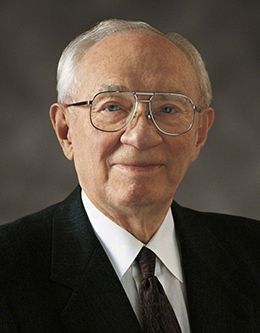 Gordon B. Hinckley was a member of the Quorum of the Twelve Apostles of The Church of Jesus Christ of Latter-day Saints when this devotional address was given at Brigham Young University on 29 October 1974.


